
Re-Sale vs One-Way Lease
Which SOC Container Strategy Fits Your Operation?
BUYING GUIDE
KD MES USA Team
5/14/20262 min read
My post content
Re-Sale vs One-Way Lease
Which SOC Container Strategy Fits Your Operation?
As container imbalance and inland reposition costs continue to increase across the U.S. logistics market, more operators are exploring flexible SOC (Shipper-Owned Container) solutions beyond traditional steamship line equipment.
Among the most common approaches are:
Re-Sale programs
One-Way Lease structures
While both models are based on SOC containers, the operational strategy and cost structure can be very different.
What Is a Re-Sale Model?
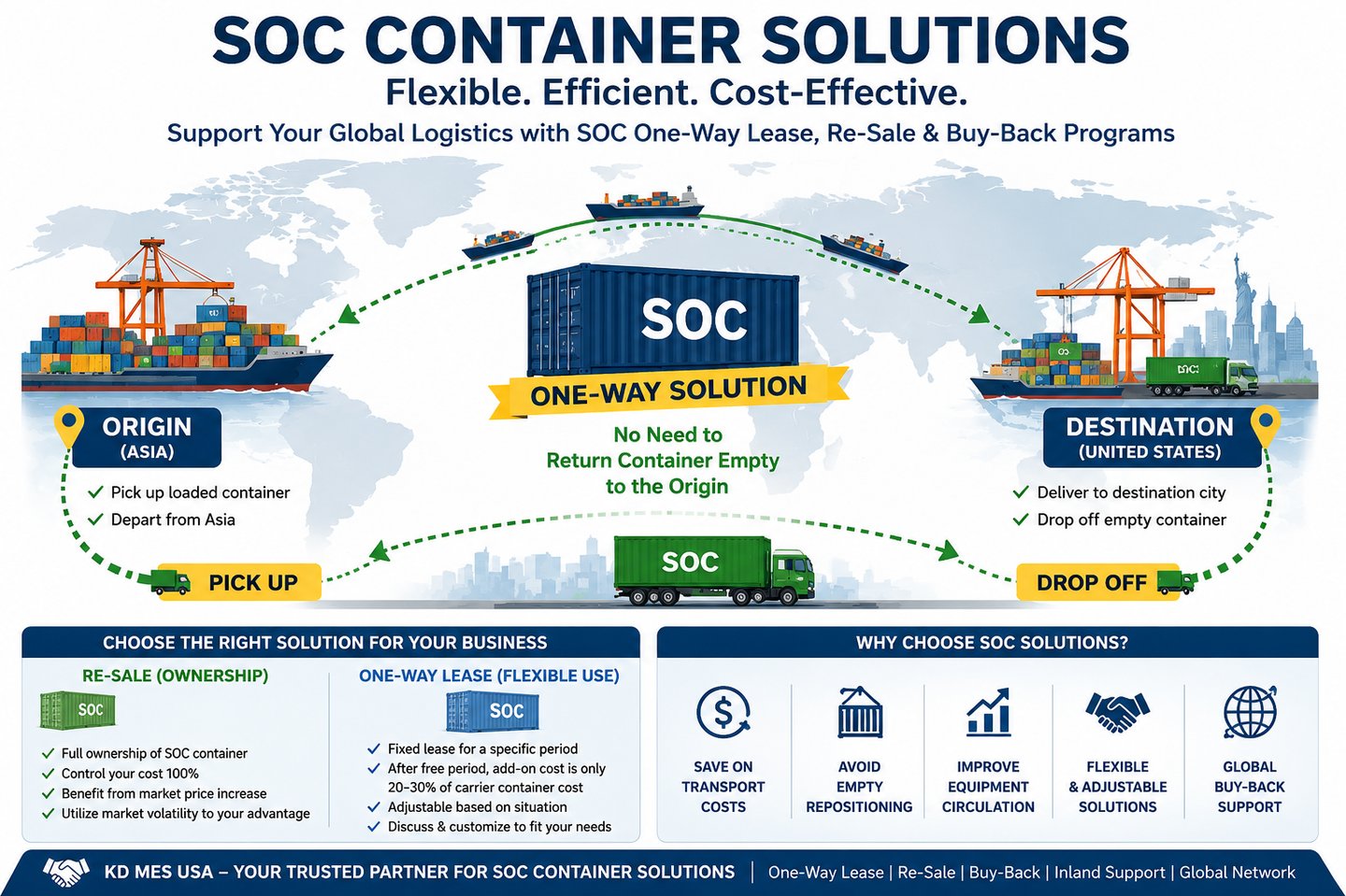
Under a Re-Sale structure, the customer fully purchases and owns the SOC container equipment.
This model allows operators to have much greater control over container procurement costs, especially in markets where container pricing is highly volatile.
Unlike carrier-owned containers, ownership provides:
✅ Full equipment control
✅ No dependency on steamship line equipment availability
✅ Reduced exposure to detention and per diem accumulation
✅ Greater flexibility for inland positioning and export operations
One of the biggest advantages of the Re-Sale model is cost control.
Because the equipment is owned directly, operators may manage container costs more predictably even during periods of significant market fluctuation.
In some situations, if used container prices increase at destination markets after cargo delivery, operators may even recover higher resale values than originally expected.
In other words, rather than simply absorbing market volatility, companies may strategically utilize changing container market conditions to improve operational efficiency and potential recovery value.
What Is a One-Way Lease Model?
Not every operator wants to own equipment or take exposure to container market fluctuations.
For companies seeking more predictable short-term operating costs, One-Way Lease programs may provide a more flexible alternative.
Under a One-Way Lease structure:
containers are leased for a specific cargo movement or operational period,
a fixed lease charge is generally agreed in advance,
and off-hire may occur at another inland location or destination market.
After the agreed free period, additional charges may apply.
However, compared to traditional steamship line container exposure, the cost increase is often significantly lower.
In many cases, the additional exposure may remain around only 20–30% of the detention or per diem cost structure typically associated with carrier-owned containers.
Why More Operators Are Looking at SOC Solutions
Today’s U.S. inland logistics market continues to face:
Empty container imbalance
Rail congestion
Depot storage limitations
Rising reposition expenses
Equipment shortages in certain regions
As a result, more operators are looking for:
flexible off-hire structures,
temporary container capacity,
inland reposition support,
and lower exposure to steamship line-related charges.
Both Re-Sale and One-Way Lease programs can help improve:
✅ Equipment circulation
✅ Inland logistics flexibility
✅ Cost visibility
✅ Export cargo support
✅ Regional equipment balancing
Which Model Is Better?
There is no single answer.
The right solution often depends on:
trade lane structure,
cargo volume,
operational period,
destination market conditions,
and the level of equipment control the customer wants.
Re-Sale may be more suitable for:
Long-term operators
Export-heavy cargo flows
Companies seeking equipment ownership
Markets with strong resale demand
One-Way Lease may be more suitable for:
Temporary projects
Short-term cargo demand
Flexible inland repositioning
Companies seeking lower operational exposure
KD MES USA SOC Solutions
KD MES USA has been supporting exporters, NVOCCs, and logistics providers in the U.S. market since 2007, backed by our global container trading and leasing network active since 1997.
We continue to support:
SOC One-Way Lease
Buy-Back solutions
Inland depot support
Equipment reposition support
Factory-direct container sourcing
across the U.S. and Canada market. In addition to supporting inland positioning within the U.S., we may also repurchase SOC containers at overseas destination markets after import cargo delivery, depending on the trade lane and local market conditions.
As inland logistics networks continue to evolve, flexible SOC container programs may become an increasingly valuable alternative for companies seeking more efficient container circulation strategies.
Contact KD MES USA
If you are interested in container trading, one-way leasing, or buy-back solutions, please contact us.
KD MES USA, Inc.
14715 S Western Ave
Gardena, CA 90249
USA
Phone: +1 310-516-9600
Email: usa@kdmes.com